Wednesday, December 28, 2011

Analyzing the Whitebark Pine Crisis

A recent article from OregonLive.com (http://www.oregonlive.com/pacific-northwest-news/index.ssf/2011/12/bad_year_for_grizzlies_with_tw.html) addresses the inevitable increase of bear attacks in Yellowstone National Park. They report that two hikers were killed in two separate maulings and that a total of ten people were attacked across the West this year. A number of scientists seem to be baffled and apparently still have not made the connection between the conflict increases and the decline of the whitebark pines and the nutrient-rich cones that they produce, a favorite late-season meal for the bears. With very little info coming out about the whitebark situation (yet with plenty of articles reporting on the "baffling" nature of this heightened aggression in the bears), I decided to do a little digging. On the website for the Interagency Grizzly Bear Study Team, I found some interesting numbers and the numbers pretty much tell the story.

On their site, the IGBST maintains a list of bear mortality records in Yellowstone and whitebark pine health data from 2009 through 2011 and the correlation between the two is undeniable. 2009 shows one of the strongest whitebark pine production years on record and the bear mortality reflects that. In going through the records, I tried to eliminate attacks that could have been in defense of cubs or carcasses and focus only on those that were abnormal or in which bears raided campsites and residential areas in search of food. In all, 9 of these incidents were recorded, with one labeled as "cause unknown" and "under investigation". That's actually not as high of a number as it sounds and is probably fairly average, maybe just slightly above.

The change recorded in 2010 is very dramatic. Whitebark pine production is shown to be alarmingly low - not the lowest on record, but a sharp turn nonetheless - with mortalities heavily increasing. Remember this is the year of the Soda Butte incident, which caused quite a stir in the bear communities. A grand total of 28 incidents occurred that summer, making the 9 of the previous year look infinitesimal by comparison and most were very abnormal. Five of these are classified as "cause unknown, under investigation" while some others are incredibly disturbing. On October 19, a bear stalked a hunter from the elk he had just killed (apparently ignoring the carcass) and twice approached to a very close range, leaving the hunter no choice but to shoot it after the second pass. On October 23, a man was threatened by a bear. After attempting to drive it away with warning shots, he blasted it with pepper spray. The bear refused to be deterred and was killed when it went after the man a second time. On October 24, a similar scenario played out. A man tried to deter an approaching bear with gunshots and ultimately bear spray but both proved ineffective and he had to shoot it at close range. It's very telling that these three incidents occurred in October when the bears were attempting to fatten up for hibernation. The cones of the whitebark pine are their primary source of fat and very few were available to them. The loss of winter-kill carcasses thanks to the wolf reintroduction program no doubt plays a heavy part in their food shortage crisis as well.

2011 shows some improvement in the health and production of the whitebark pines but still not quite where the numbers need to be and a large number of abnormal bear incidents were still reported, totaling 27, with ten of those being "unknown, under investigation". In one case, a bear who killed a hiker presumably in a surprise encounter in July was later found present at the site of another death in August.

This data presents a very clear picture, yet so many scientists are still studying the whitebark pine situation - or just pretending to - and wildly speculating on the cause of the increased conflicts, while many bear advocates and enthusiasts have been left feeling as if they're standing on very shaky ground by these attacks. No doubt the rising bear population in Yellowstone is playing a big part, as there aren't enough food resources to go around. If this trend continues, the bears will spread outside of the park boundaries, if they haven't already, and the intolerance they're going to run into, and are already being met with, will not be pretty.

For more info and a look at the data gathered by the IGBST, go here: http://nrmsc.usgs.gov/research/igbst-home.htm

Tuesday, December 20, 2011

Data vs. Dogma

In all the controversy surrounding bears, nothing gets people more riled up than the issue of feeding them. It's long been the idea that feeding bears will ultimately make them dangerous to people but, as with all things bear, a closer look should be taken and more consideration should be given to the complexities and varied personalities of the animals before one simple vague answer is provided. This line of thinking came about as a result of the infamous "night of the grizzlies", though strong evidence suggests that the bear responsible for Julie Helgeson's death was not a garbage feeder. The park service wanted the matter closed, though, and did not put much stock in said evidence. Thus was born the idea that bears exposed to human food would inexplicably become man-eaters. Yet Charlie Russell fed his bears without them becoming a threat to him or losing the ability to function as wild animals, as did Charlie Vandergaw, Benjamin Kilham, Lynn Rogers, Jack and Patti Becklund, etc., etc. So what's going on here? Why have these people not fallen prey to a vicious bloodbath or created a situation where someone else would?

Allen Piche has been feeding black bears in British Columbia for 25 years with no problems either. A total of 24 bears would often frequent his home for companionship and dog food, only 2 miles from Christina Lake, an urban populated area. During that time, no bears caused problems at the lake, but Allen was arrested and tried because of the possibility that something could happen. Shortly thereafter, a rash of bear problems broke out at the lake and 18 persistent black bears were shot and killed, in an area that usually only receives half a dozen bear visits per summer season. The obvious conclusion put forth by the Ministry of Environment is that Allen's bears had become so dependent on human food that they had essentially forgotten how to be wild and went to the nearest human community in search of hand-outs. A scarcity of natural foods that year just made the situation even more volatile. Remarkably, when Allen was allowed to return home, 20 of his 24 bears returned to greet him, alive and well. None of them had been responsible for the issues at Christina Lake! The missing four had departed earlier in the summer and had not returned. Speaking with his immediate neighbors, Allen was delighted to find that none of them had had any problems with bears and did not have any hanging around.

Allen continued to provide some food for the bears - though much less this time - and noted that they began to spend more and more time foraging in the nearby woods. Undercover officers posing as curious photographers caught Allen in the act and he was re-arrested.

Allen has been a friend of mine through Facebook for some time now, ever since his discovery of my blog. We spoke several times about diversionary feeding, as he was making a case to present to the Ministry, showing how that could be used to get the bears back into the wild, and he read my post Of Bears and Bureaucrats (February 2, 2011), which relates how John and Frank Craighead studied garbage bears in Yellowstone and found that not only did they not pose a greater threat to people, they were still fully functional as wild bears. When the Craigheads presented evidence that the dumps should be closed slowly so that the bears could be properly weaned off the garbage rather then be left hanging, park managers disregarded the data and created a near-catastrophe. Allen was inspired by what the Craigheads had discovered and intended to use it in his defense, in hopes of persuading the Ministry to think before they act.

Diversionary feeding is a very new idea, so new that many researchers balk at it because it involves humans feeding bears. When problem bears surface, feeding stations are placed deep in the woods as a means of drawing them back into the wild, and these stations are moved further and further each day until the bears have been removed to a comfortable distance. The few states that have put diversionary feeding plans into effect as a more peaceful solution than bullets have reported an almost 100% success rate at solving problem bear issues. When Allen presented this idea to the Ministry, they were livid at the thought of providing bears with food because of the chaos they were sure would occur, despite the fact that all of the data Allen had gathered supported his side of the argument and the Ministry had nothing but old ideologies to support theirs. Still, Allen is not a wildlife biologist and 25 years of hands-on, practical experience is apparently invalidated by that little detail, whereas the Ministry officers hold the degrees and the official titles and all the lack of facts and experience that go with that, so of course they won. Now Allen awaits sentencing for the feeding, while the Ministry concentrates its attention on shooting more bears at Christina Lake, convinced that Allen's bears are causing all the problems. What's ironic is that, considering the lack of natural foods at the time, Allen's feeding of the bears acted as a sort of diversionary feeding program in itself, keeping these specific bears OUT of trouble, stopping them from going down in search of scraps at Christina Lake, where they still have not set one foot! They did not grow to depend solely on human food, they merely used it as a necessary supplement whenever natural foods were unavailable. Unlikely that the Ministry will ever be willing to see this, though.

On the Lily the Black Bear Facebook page, Lynn Rogers posted his thoughts on this issue and summed it up brilliantly: "Education about the true nature of black bears and about what creates bear-human conflict and what can prevent it can save so many bears. The same principles undoubtedly apply to bears around the world. It is hard to get past the untested assumptions that have been the basis for professional bear management for so long. It is hard to get past the exaggerated fear that drives liability concerns and leads to so many bears being killed unnecessarily. It is hard for most people to see black bears for what they are - basically shy animals trying to make a living while staying out of trouble. Not demons. Not the angry beasts of magazine covers and TV programs. Just the bears that we have come to know and understand in our 45 years of research. If bears behaved the way many experts and the media say they do, we could not have done what we have done with them these several decades."

On the issue of the continual head-butting between new facts and old ideas, Rogers provided a link to this blog post that sums it all up extraordinarily well: http://www.jonathanfields.com/blog/judgment-be-damned/

For more info, you can check out Allen's website at: http://thebeardude.net/
His "Observations" page is of special note, a presentation of facts attained through real, practical research: http://thebeardude.net/?page_id=283

Wednesday, October 26, 2011

Are We Fighting a Losing Battle?

On the website for the Alaska Department of Fish and Game (hereby referenced as ADF&G), it is stated that their mission is to protect and conserve as many natural habitats and wild species as possible, for the recreation and enjoyment of future generations. After spending so much time working with captive bears in Alaska and seeing firsthand how they execute their policies, I seriously have to wonder if they've even bothered to read their own mission statement. Certainly if you were unfortunate enough to be a bear in these parts, you would no doubt think the same thing, considering that you would be getting the shaft no matter what you tried to do.

Long-time readers no doubt remember my post "Fight For Life" (June 7, 2010) and the controversy that erupted in Sitka over the department's attempt to confiscate and euthanize Seek, the black bear cub, after putting him in our hands. As brutal as that confrontation was, it ultimately served to pave the way to what seemed an alliance between ADF&G and Fortress of the Bear, an alliance that saved the lives of Toby, Baloo, and Lucky last year and, in mid-2011, a grizzly cub named Pandora who now resides at the Montana Grizzly Encounter as Lucy. An incident that took place earlier this summer - one that I was not present for, but that I followed through second-hand info - makes me wonder if that alliance really means anything in the department's eyes.

A few months ago, three orphaned brown bear cubs were found on the shores of Bristol Bay on the western coast of the Alaskan Peninsula. As per the new agreement, ADF&G notified Fortress of the Bear of the cubs and, because the Fortress did not have room for them or the funds to construct new holding areas, the department gave them a short window of time in which to find a home for the three young grizzlies. It was tight but a home was located with Mike McIntosh and his Bear With Us sanctuary in Ontario, Canada. Unfortunately Fish and Game requires that potential homes meet an extensive number of specific, and often ludicrous, requirements before cubs will be transferred. That, coupled with the ridiculously short amount of time that the department allows for sanctuaries to meet these requirements, Mike was unable to complete the upgrades and the cubs were destroyed. This prompted quite a backlash against the department, including from Mike himself, about the impossibility of accomplishing such involved demands.

An example of just how ludicrous some of these demands can be. When Les and Evy Kinnear first started the Fortress, Fish and Game officials were sent to inspect the habitats and took issue with steel bolts jutting out one inch from the insides of the abandoned clarifier tanks, fourteen feet above ground. They insisted that the bolts be removed, otherwise the bears would crazily throw themselves against the wall and be impaled. Another official, this one an actual biologist for the department, insisted that the pool areas be drained because bears did not like water and would not go in. Well, I can personally attest to the fact that not only do the bears love the water, they spend eight hours a day in the water!

Even worse, two years ago a starving cub was found right outside the gates of the Fortress. The owners of the facility planned to take the cub in but when someone called to notify Fish and Game, they promptly showed up and shot the cub. The question of why is one that is still asked today and I wish there were some sensible way to answer it. As it stands, it seems that they merely find bullets to be the easiest response, ruling out the hassle of tracking and capturing the animal, the resulting piles of paperwork, and the tedious task of finding a home, a task made all the more tedious by Fish and Game's refusal to put the word out whenever new cubs are acquired. Instead, they wait for zoos and sanctuaries to contact them and ask if orphans are available. Not a very wise-move and not a move that a supposedly conservation-minded organization should approve of, especially considering how much bears contribute to an ecosystem as an umbrella species, but again it is the easiest route requiring the least amount of effort.

Several weeks ago, I heard second-hand that there were three more orphaned cubs somewhere in Alaska and the search was underway to find a home. I have heard no new info on this story since, so I fear that the outcome may have been inevitably grim, not just because of Fish and Game's overly involved requirements but because of the lack of facilities available to take the cubs. There are so few sanctuaries - and even fewer that deal primarily with bears - that facilities with sufficient space are very difficult to find. On top of that, many facilities are either not registered with ADF&G or are unwilling to endure the hundreds of pages of paperwork and requirements in order to get new cubs. Meanwhile, for that very reason, rescue efforts in Alaska are a continuously losing battle. I'm aware of half a dozen cubs that were killed this summer alone because homes could not be found, but I wouldn't be surprised if the numbers were actually much higher. Considering the very large brown bear population on Baranof Island, where Sitka is located, this will no doubt be a recurring theme next summer and in years to come, at least as long as Fish and Game is calling the shots.

If you have a sanctuary or a license to privately own bears, I encourage you to get registered with ADF&G, get the paperwork out of the way, and let's start saving these cubs instead of losing them.

Monday, September 26, 2011

The Loss of Hope?

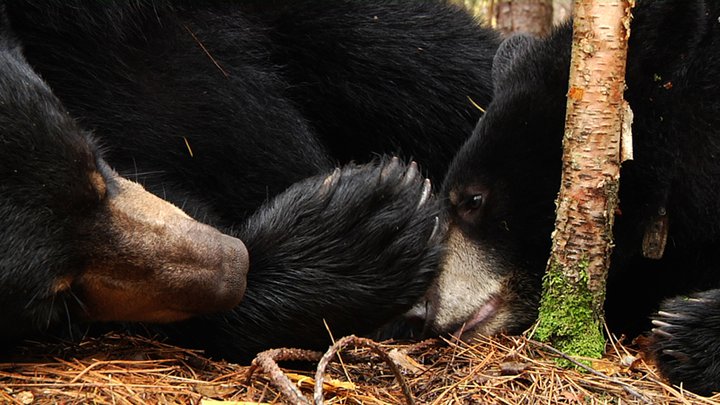
Hope (the smaller bear on the right) is missing and believed to be dead.

In early 2010, Dr. Lynn Rogers of the North American Bear Center in Ely, Minnesota placed a webcam in the winter den of a wild black bear named Lily, a bear that had learned to trust him and who Lynn walked with as part of his ongoing research. That January, as thousands of people watched live over the internet, a cub was born and, along with her, an internet sensation. So many people gained such a radically new perspective of black bears from this event that the cub was named Hope. After tens of thousands of people followed the winter lives of mother and cub, the webcam was re-installed this year and captured the arrival of two more cubs, one of whom tragically died early in the season.

Now that it's September and the Minnesota hunting season is in full swing, Hope has suddenly disappeared and all evidence points to her death at the hands of a hunter who intentionally targeted, baited, and killed her just to spite Lynn and the legions of fans who have followed the lives of these bears.

When hunting season begins, Lynn attaches brightly colored ribbons onto the radio collars of his bears so that they stand out and can be identified as research animals, which most ethical hunters will not shoot. Unfortunately, Hope kept removing her collar and would not wear it. She disappeared on September 14th. Lily and her surviving cub, Faith, visited the hunter's bait pile where she was last seen on September 15th, 16th, and 17th and have not returned to that area since.

Lynn has recently stated that he knows the hunter who left the bait and knows that he would not shoot a research bear, but doubt is now starting to form. This same hunter left posts on a Lily Facebook page last week boasting of "Hope jerky" and "Hope cooked in a crockpot". Lynn now reluctantly wonders if the killing of Hope was deliberate and intentional. He is now waiting to hear from the DNR if a bear matching the cub's description has been registered.

Meanwhile, the reaction from those who followed the birth and growth of this cub is one of devastation. Hundreds of posts of mourning and grief have been added to Lily's Facebook page and Lynn has said that schoolteachers who were using the webcam broadcasts as an educational tool have called him in tears wondering how they were going to break the news to their students. Lynn himself is distraught and feels that with so much to learn from this family, this has been a major blow to his research.

While the hunting of radio-collared bears is perfectly legal in Minnesota, with Hope being no exception, it's the apparent deliberate aspect of this incident that makes it most infuriating. It takes a truly sick mind to intentionally set out to shatter something that has meant so much to so many just to make a name for himself - be that name good or bad - but the opposition faced by bear researchers, keepers, and advocates can be an overwhelming one and the list of travesties is ever-growing. While some are keeping their fingers crossed for a happy ending, every passing day makes a tragic one even more certain.

Update - September 27th:

It's now confirmed that Hope is dead. She was killed September 16th by a hunter at a bait pile. It's been clarified that this was not the same man who posted comments on Facebook apparently bragging about her death and that the shooting was accidental. Even so, this remains a deep loss and a difficult time for all of those who have followed these bears since the cub's birth.

Friday, September 23, 2011

Meanwhile, Back In Sitka...

After almost a year away, Killisnoo says: "Where have you been?"

I'm currently re-visiting my old stomping grounds at Fortress of the Bear in Sitka and it's been a very fulfilling and rewarding experience to observe and interact with the bears again. While Toby, Baloo, and Lucky have gotten much bigger (to the point where I have difficulty telling them apart), Chaik and Killisnoo seem to be their old selves, yet are visibly tired from the very busy summer they've just had. On top of the joy of watching them fish for salmon in their pool, I've also gained some new insights into bear intelligence and behavior, regarding the usage of tools and complex thinking to solve problems.

As related to me by Les (executive director of the Fortress), several weeks ago a whole chicken was hung from the bridge above the pool about two feet higher than the bears could reach. While Chaik and Killisnoo made their best efforts, they were unable to reach the meal. Exasperated, they sat on the shore for five whole minutes, staring at the chicken as if wondering how to get to it. Finally, with no spoken language and no visible communication between them, Chaik stood and began walking around the far end of the pool. Killisnoo stood and quietly followed him. Upon reaching the far side, Chaik rolled a stump end over end into the water until it was standing beneath the chicken. The stump was unsteady where it sat so Killisnoo put his full weight against it and held it steady while Chaik climbed to the top and retrieved the snack.

In the second account, Killisnoo inadvertently discovered how to catch fish in the pool by using the limbs of a dead Christmas tree as an impassable net or as a structure that the fish would seek to take shelter in. After attempting this a couple of times, he learned that the limbs could act as a trap and so he moved more trees into the water. One could almost see the gears turning in his head as he gained a clearer understanding of what he was constructing. Finally, after almost creating a fully functional fish weir, he seemed to lose whatever he was on the verge of grasping and abandoned the project. Still, there is one tree remaining in the water and he does frequently check it for fish.

I'm personally fascinated by these accounts, as they demonstrate a high level of complex thinking and problem solving ability. This, to me, is one of the highest values of captive bears that many opponents to the practice do not see: the opportunity to witness these behaviors, to understand that they are complex and intelligent creatures, and to gain not only insight into how to co-exist with them but to gain the desire to. I think that facilities like Fortress of the Bear are going a long way to help promote that kind of thinking.

Sunday, August 28, 2011

The Edge of Eden: Living With Grizzlies

Finally, after a long wait and many attempts to acquire a copy of this film, The Edge of Eden: Living With Grizzlies, a documentary showcasing the work of Charlie Russell after the events he wrote about in Grizzly Heart, has been made available online. The film is fascinating and some of what's shown onscreen will be discussed in future blog posts. You can watch the film here: http://www.cutv.ws/documentary/watch-online/festival/play/6781/The-Edge-of-Eden--Living-with--Grizzlies

Currently I'm spending time in Fairbanks, Alaska with no internet connection aside from public wifi hotspots, resulting in a lack of blog updates. Fortunately I do have a few ideas I want to work on, so you can expect new posts and topics to be coming soon!

Thursday, June 9, 2011

The Horrors of Bear Bile Farming

I recently inquired about a job at Bear Country USA, a bear sanctuary and animal park in Rapid City, South Dakota. The deal was pretty well in the bag until I discovered their history of killing bears in order to harvest and sell the gall bladders. Despite this being an act of illegal poaching, somehow it was handled legally under a state permit. However that happened, it killed the job prospects for me and made me realize that I had never posted a topic about the insidious practice of bear bile farming, an issue of extreme importance.

Across China and Vietnam, an estimated 12,000 to 14,000 Asiatic black bears (also called moon bears) are kept in captivity for the purpose of harvesting the bile produced by their livers and stored in their gall bladders, due to concentrations of ursodeoxycholic acid (UDCA), which is used in traditional Chinese medicine to reduce fever, improve eyesight, and break down gallstones. Others claim that it actually has no medicinal value at all and is instead sold as an aphrodisiac. Either way, the high demand for the bile has led to extensive farming of bears.

In the bile extraction process, the bears are kept in "crush cages" that are not much bigger than the animals themselves. While this allows for easier access to the abdomen, it also prevents the bears from standing and, in some cases, from moving at all, often resulting in the animal's skin growing around the bars of the cages. When the skin is pulled free, it can leave wounds up to three feet in diameter. Many of the bears spend most of their lifetimes in these cages and develop mental illnesses or physical defects. Hair loss, malnutrition, and loss of muscle mass afflict these bears, and they often have their teeth and claws either extracted or filed down. Many of the bears are inflicted with so much pain that they wail and moan, slam their heads against the bars of their cages, or even chew off their own paws. When the bears stop producing bile, they are either left to starve in their cages or are killed for their meat, fur, paws, and gall bladders.

The bile extraction process itself is extremely horrific, occurring through an implanted tube. Other methods involve pushing a hollow steel stick through the bear's abdomen. A new free drip method has since been developed that is regarded as "more humane"; however, in this procedure, a permanent hole is opened into the bear's abdomen and gall bladder, allowing the bile to drip out freely. Sometimes the hole is kept open with a perspex catheter, causing severe pain.

Because only minute amounts of the bile are used in Chinese medicine, a total of 500 kg of extracted bile is used by practitioner's every year, but more than 7,000 kg are being harvested, with the surplus being used in non-essential products such as wine, eyedrops, and other general tonics. The bottom line is that alternative medicines do exist and are just as effective, making the harvesting of bear bile unnecessary and irrelevant.

Chinese bear farmers inexplicably argue that farming reduces the demand for the harvesting of wild bears. Official reports indicate that 7,600 bears are farmed in China and that 10,000 wild bears would need to be killed each year to produce the same amount of bile. However, in some countries poachers are capturing and selling live bears to these farms anyway or are harvesting gall bladders from wild bears in hopes of making their own fortune. Charlie Russell witnessed - and was personally affected - by this kind of activity during his time in Kamchatka, Russia.

In 1993, Nottingham, England resident Jill Robinson visited a bear bile farm in China. She quietly broke away from her tour group and descended a flight of stairs to a dark basement, where she came face to face with the bear cages. She was horrified and, while most of the bears reacted fearfully to her presence, one reached out with its paw and touched her. Robinson reciprocated, holding the paw in her hand. From that moment on, there was no turning back.

For the next seven years, Robinson researched the way bile is used and negotiated a deal with the Chinese government. In 2000, the Sichuan Forestry Department signed a pledge with the China Wildlife Conservation Association to release 500 bears from the bile farms with the worst living conditions. This marked the first time an agency of the Chinese government had come to an official agreement with an animal welfare organization. To house the released bears, Robinson founded Animals Asia Foundation and established a bear rescue center in Chengdu. The foundation has since begun a similar sanctuary in Vietnam.

Incredibly, when the rescued bears began arriving at the sanctuary, workers reported that they initially reacted fearfully and aggressively to people but became friendly and warm when they began to understand that they were being cared for and were not in any danger, demonstrating a very forgiving nature.

While the formation of Animals Asia is a major victory, the horrors of bear bile farming and poaching still continue. It is a monstrous, inhuman torture that must be stopped. We've already seen in this blog how exposure of bears to such kinds of human violence can instigate aggression and attacks on people, so there could be a very dark, negative impact to all of this beyond the effects on the animals. It could very literally come back to bite us. For more information on bile farming, including ways to help, please visit www.animalsasia.org