Monday, September 26, 2011

The Loss of Hope?

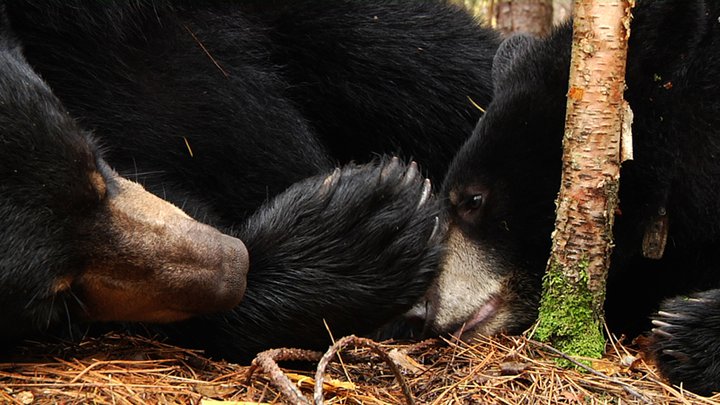
Hope (the smaller bear on the right) is missing and believed to be dead.

In early 2010, Dr. Lynn Rogers of the North American Bear Center in Ely, Minnesota placed a webcam in the winter den of a wild black bear named Lily, a bear that had learned to trust him and who Lynn walked with as part of his ongoing research. That January, as thousands of people watched live over the internet, a cub was born and, along with her, an internet sensation. So many people gained such a radically new perspective of black bears from this event that the cub was named Hope. After tens of thousands of people followed the winter lives of mother and cub, the webcam was re-installed this year and captured the arrival of two more cubs, one of whom tragically died early in the season.

Now that it's September and the Minnesota hunting season is in full swing, Hope has suddenly disappeared and all evidence points to her death at the hands of a hunter who intentionally targeted, baited, and killed her just to spite Lynn and the legions of fans who have followed the lives of these bears.

When hunting season begins, Lynn attaches brightly colored ribbons onto the radio collars of his bears so that they stand out and can be identified as research animals, which most ethical hunters will not shoot. Unfortunately, Hope kept removing her collar and would not wear it. She disappeared on September 14th. Lily and her surviving cub, Faith, visited the hunter's bait pile where she was last seen on September 15th, 16th, and 17th and have not returned to that area since.

Lynn has recently stated that he knows the hunter who left the bait and knows that he would not shoot a research bear, but doubt is now starting to form. This same hunter left posts on a Lily Facebook page last week boasting of "Hope jerky" and "Hope cooked in a crockpot". Lynn now reluctantly wonders if the killing of Hope was deliberate and intentional. He is now waiting to hear from the DNR if a bear matching the cub's description has been registered.

Meanwhile, the reaction from those who followed the birth and growth of this cub is one of devastation. Hundreds of posts of mourning and grief have been added to Lily's Facebook page and Lynn has said that schoolteachers who were using the webcam broadcasts as an educational tool have called him in tears wondering how they were going to break the news to their students. Lynn himself is distraught and feels that with so much to learn from this family, this has been a major blow to his research.

While the hunting of radio-collared bears is perfectly legal in Minnesota, with Hope being no exception, it's the apparent deliberate aspect of this incident that makes it most infuriating. It takes a truly sick mind to intentionally set out to shatter something that has meant so much to so many just to make a name for himself - be that name good or bad - but the opposition faced by bear researchers, keepers, and advocates can be an overwhelming one and the list of travesties is ever-growing. While some are keeping their fingers crossed for a happy ending, every passing day makes a tragic one even more certain.

Update - September 27th:

It's now confirmed that Hope is dead. She was killed September 16th by a hunter at a bait pile. It's been clarified that this was not the same man who posted comments on Facebook apparently bragging about her death and that the shooting was accidental. Even so, this remains a deep loss and a difficult time for all of those who have followed these bears since the cub's birth.

Friday, September 23, 2011

Meanwhile, Back In Sitka...

After almost a year away, Killisnoo says: "Where have you been?"

I'm currently re-visiting my old stomping grounds at Fortress of the Bear in Sitka and it's been a very fulfilling and rewarding experience to observe and interact with the bears again. While Toby, Baloo, and Lucky have gotten much bigger (to the point where I have difficulty telling them apart), Chaik and Killisnoo seem to be their old selves, yet are visibly tired from the very busy summer they've just had. On top of the joy of watching them fish for salmon in their pool, I've also gained some new insights into bear intelligence and behavior, regarding the usage of tools and complex thinking to solve problems.

As related to me by Les (executive director of the Fortress), several weeks ago a whole chicken was hung from the bridge above the pool about two feet higher than the bears could reach. While Chaik and Killisnoo made their best efforts, they were unable to reach the meal. Exasperated, they sat on the shore for five whole minutes, staring at the chicken as if wondering how to get to it. Finally, with no spoken language and no visible communication between them, Chaik stood and began walking around the far end of the pool. Killisnoo stood and quietly followed him. Upon reaching the far side, Chaik rolled a stump end over end into the water until it was standing beneath the chicken. The stump was unsteady where it sat so Killisnoo put his full weight against it and held it steady while Chaik climbed to the top and retrieved the snack.

In the second account, Killisnoo inadvertently discovered how to catch fish in the pool by using the limbs of a dead Christmas tree as an impassable net or as a structure that the fish would seek to take shelter in. After attempting this a couple of times, he learned that the limbs could act as a trap and so he moved more trees into the water. One could almost see the gears turning in his head as he gained a clearer understanding of what he was constructing. Finally, after almost creating a fully functional fish weir, he seemed to lose whatever he was on the verge of grasping and abandoned the project. Still, there is one tree remaining in the water and he does frequently check it for fish.

I'm personally fascinated by these accounts, as they demonstrate a high level of complex thinking and problem solving ability. This, to me, is one of the highest values of captive bears that many opponents to the practice do not see: the opportunity to witness these behaviors, to understand that they are complex and intelligent creatures, and to gain not only insight into how to co-exist with them but to gain the desire to. I think that facilities like Fortress of the Bear are going a long way to help promote that kind of thinking.

Sunday, August 28, 2011

The Edge of Eden: Living With Grizzlies

Finally, after a long wait and many attempts to acquire a copy of this film, The Edge of Eden: Living With Grizzlies, a documentary showcasing the work of Charlie Russell after the events he wrote about in Grizzly Heart, has been made available online. The film is fascinating and some of what's shown onscreen will be discussed in future blog posts. You can watch the film here: http://www.cutv.ws/documentary/watch-online/festival/play/6781/The-Edge-of-Eden--Living-with--Grizzlies

Currently I'm spending time in Fairbanks, Alaska with no internet connection aside from public wifi hotspots, resulting in a lack of blog updates. Fortunately I do have a few ideas I want to work on, so you can expect new posts and topics to be coming soon!

Thursday, June 9, 2011

The Horrors of Bear Bile Farming

I recently inquired about a job at Bear Country USA, a bear sanctuary and animal park in Rapid City, South Dakota. The deal was pretty well in the bag until I discovered their history of killing bears in order to harvest and sell the gall bladders. Despite this being an act of illegal poaching, somehow it was handled legally under a state permit. However that happened, it killed the job prospects for me and made me realize that I had never posted a topic about the insidious practice of bear bile farming, an issue of extreme importance.

Across China and Vietnam, an estimated 12,000 to 14,000 Asiatic black bears (also called moon bears) are kept in captivity for the purpose of harvesting the bile produced by their livers and stored in their gall bladders, due to concentrations of ursodeoxycholic acid (UDCA), which is used in traditional Chinese medicine to reduce fever, improve eyesight, and break down gallstones. Others claim that it actually has no medicinal value at all and is instead sold as an aphrodisiac. Either way, the high demand for the bile has led to extensive farming of bears.

In the bile extraction process, the bears are kept in "crush cages" that are not much bigger than the animals themselves. While this allows for easier access to the abdomen, it also prevents the bears from standing and, in some cases, from moving at all, often resulting in the animal's skin growing around the bars of the cages. When the skin is pulled free, it can leave wounds up to three feet in diameter. Many of the bears spend most of their lifetimes in these cages and develop mental illnesses or physical defects. Hair loss, malnutrition, and loss of muscle mass afflict these bears, and they often have their teeth and claws either extracted or filed down. Many of the bears are inflicted with so much pain that they wail and moan, slam their heads against the bars of their cages, or even chew off their own paws. When the bears stop producing bile, they are either left to starve in their cages or are killed for their meat, fur, paws, and gall bladders.

The bile extraction process itself is extremely horrific, occurring through an implanted tube. Other methods involve pushing a hollow steel stick through the bear's abdomen. A new free drip method has since been developed that is regarded as "more humane"; however, in this procedure, a permanent hole is opened into the bear's abdomen and gall bladder, allowing the bile to drip out freely. Sometimes the hole is kept open with a perspex catheter, causing severe pain.

Because only minute amounts of the bile are used in Chinese medicine, a total of 500 kg of extracted bile is used by practitioner's every year, but more than 7,000 kg are being harvested, with the surplus being used in non-essential products such as wine, eyedrops, and other general tonics. The bottom line is that alternative medicines do exist and are just as effective, making the harvesting of bear bile unnecessary and irrelevant.

Chinese bear farmers inexplicably argue that farming reduces the demand for the harvesting of wild bears. Official reports indicate that 7,600 bears are farmed in China and that 10,000 wild bears would need to be killed each year to produce the same amount of bile. However, in some countries poachers are capturing and selling live bears to these farms anyway or are harvesting gall bladders from wild bears in hopes of making their own fortune. Charlie Russell witnessed - and was personally affected - by this kind of activity during his time in Kamchatka, Russia.

In 1993, Nottingham, England resident Jill Robinson visited a bear bile farm in China. She quietly broke away from her tour group and descended a flight of stairs to a dark basement, where she came face to face with the bear cages. She was horrified and, while most of the bears reacted fearfully to her presence, one reached out with its paw and touched her. Robinson reciprocated, holding the paw in her hand. From that moment on, there was no turning back.

For the next seven years, Robinson researched the way bile is used and negotiated a deal with the Chinese government. In 2000, the Sichuan Forestry Department signed a pledge with the China Wildlife Conservation Association to release 500 bears from the bile farms with the worst living conditions. This marked the first time an agency of the Chinese government had come to an official agreement with an animal welfare organization. To house the released bears, Robinson founded Animals Asia Foundation and established a bear rescue center in Chengdu. The foundation has since begun a similar sanctuary in Vietnam.

Incredibly, when the rescued bears began arriving at the sanctuary, workers reported that they initially reacted fearfully and aggressively to people but became friendly and warm when they began to understand that they were being cared for and were not in any danger, demonstrating a very forgiving nature.

While the formation of Animals Asia is a major victory, the horrors of bear bile farming and poaching still continue. It is a monstrous, inhuman torture that must be stopped. We've already seen in this blog how exposure of bears to such kinds of human violence can instigate aggression and attacks on people, so there could be a very dark, negative impact to all of this beyond the effects on the animals. It could very literally come back to bite us. For more information on bile farming, including ways to help, please visit www.animalsasia.org

Friday, April 22, 2011

Tolerance of Grizzlies

New and interesting article from the Helena, Montana newspaper about the role public education will play in the management of grizzlies. It's about time somebody took this idea seriously.

http://helenair.com/lifestyles/article_a55f8940-6be3-11e0-a720-001cc4c03286.html

Sunday, April 10, 2011

Book Review - The Story Of Brutus

With all the bear people I've introduced you to in this blog - from trainers to zookeepers to biologists to conservationists - it's truly criminal that I have not yet included Casey Anderson in that list, despite the fact that he is one of the top bear communicators in the world and has successfully raised a grizzly bear to be his best friend. What better way to correct that error than with a review of Casey's 2010 book The Story of Brutus.

Casey Anderson, now the host of National Geographic's Expedition Wild, met a young grizzly cub named Brutus in a wildlife preserve where Anderson had built a unique relationship with Brutus's father (which is detailed in the first chapter of the book). With the likelihood that Brutus would be euthanized due to overpopulation at the preserve, Anderson started the Montana Grizzly Encounter, a rescue and educational facility, for Brutus and other captive bears born into unfortunate situations. Seeking advice from Doug Seus, Casey learned firsthand how to interact with bears at a face-to-face level and Brutus has since become not only Casey's co-star on television but his right-hand man as well.

The book details many of Casey's childhood wildlife adventures, including early experiences with his father. The encounters related are stirring, thrilling, sometimes hair-raising, and always entertaining. Along the way, Casey refutes many misconceptions about bears, pleads a case for saving the grizzlies, and even attempts to teach Brutus to fish like a wild bear. Scattered throughout are amazing insights into his relationship with Brutus and how that relationship is maintained. Finally - and perhaps most remarkably for the bear enthusiast - Casey relates two accounts in which Brutus seems to shed actual tears of joy, an incredible look into the true emotional capability of these animals.

Overall the book is a great read and another valuable look into the heart and mind of an animal that is misunderstood by so many. Highly recommended and I can't wait for Casey's next literary outing.

For more information: www.grizzlyencounter.com

Sunday, March 20, 2011

In Defense of Polar Bears


After focusing primarily on grizzlies and black bears in previous posts, I felt it was high time that the polar bears got to have their say in the matter. This is a post that I've been wanting to do for the better part of a year but it's been a long process tracking down all the source material and compiling all of the pertinent information, because - of all the bears - we seem to know the least about the polar bear. One thing that most people do seem to agree on is that the polar bear is the most predatory of the main three in North America, the only one that will frequently regard people as a food source. But is this really true? Despite a few nasty encounters, including some predatory attacks, evidence suggests that this is not the norm.

While bears are primarily classified as omnivores, the polar bear is the only one that is a true carnivore, a necessity due to the lack of vegetation in their icy environment. This is what leads to the common thought that they will usually prey on man, though polar bear attack statistics are extremely low when compared to grizzlies and black bears. While it is true that this is mostly due to the fact that man and polar bear share very little space together, it could also be an indication that the polar bear is not as aggressive as it is often thought to be.

In The World of the Polar Bear, Norwegian Thor Larsen says that he has experienced at least a dozen attacks from polar bears, but that all of them were provoked. Russian researcher Nikita Ovsyanikov, who lived and walked with the polar bears of Wrangel Island and who wrote two invaluable books about the experience - Living With The White Bear and Polar Bears - has had over fifteen hundred encounters with these animals and says that only three of those encounters were with bears that tried to kill him. Even then, he says that he made mistakes that provoked that behavior. In all three incidents, he says that he was able to stop the attacks by carrying a stick, behaving in a confident and aggressive manner, making himself look larger with his parka, and using pepper spray, which has a 100% success rate against polar bears due to the sensitivity of their extremely keen noses (they can often scent seals from up to 25 miles away).

Polar bears can often be the most curious of all bears and have been known to follow people across ice flows, wander into camps, and even poke their heads into tents. With the image of a man-eater in mind, these bears are usually killed right away, without even signs of aggression being apparent. So is the polar bear that peeks inside your tent looking for a meal, or is he simply curious about what's inside? In 1978, Naomi Uemura made the first solo trek into the North Pole and wrote about the experience in National Geographic. He tells the story of a polar bear that entered his camp and approached his tent. Tucked away in his sleeping bag, Uemura was sure he was doomed, particularly when the bear began shredding the tent. However, after one sniff of Uemura in his sleeping bag, the bear turned and padded away.

In October of 2003, the nuclear submarine USS Honolulu surfaced near the North Pole. A lookout onboard spotted three polar bears nearby, who promptly wandered over to the strange thing and began to curiously investigate it, showing no fear, despite having never seen such an object before. In 1990, Nikita Ovsyanikov was reading in his cabin on Wrangel Island one night and suddenly found that the structure was surrounded by polar bears who were peering in the windows and pawing at the walls. Ovsyanikov simply went outside, shooed the bears away, and closed the shutters. Charles Jonkel wrote of tranquilized and captured polar bears, saying that they were as docile as black bears when approached by investigators. Many other researchers who work with the bears on the ice flow have said that they are no more aggressive than the average North American black bear. The gentle side of the polar bear can even be seen in a series of remarkable photographs in which one of the white bears returned to a campsite every night for a week to play, wrestle, and cuddle with a chained-up sled dog (see photos above).

Churchill, Manitoba is considered to be the polar bear capital of the world but there have only been two recorded attacks there since 1717. The locals do face many problem bears, though, but they are easily deterred. More info and even a few amusing stories of face-to-face encounters can be found at the website for Polar Bears International: http://www.polarbearsinternational.org/polar-bears/bear-essentials-polar-style/human-interaction/attacks-and-encounters

Polar bears are also considered to be one of the most intelligent of all bears, as Else Poulsen shows in her wonderful book Smiling Bears. One of her captive polar bears pointedly demonstrated to her why frozen chickens don't make acceptable toys: they thaw out in water. The bear demonstrated this by first catching and holding Else's attention, then using her paw to slosh the bird around in the pool until it thawed, and then slapping it out of the water to show that it would fall apart.

I've shown throughout the course of this blog that there is much we don't understand about bears - all bears - but I think it's very clear that there's even more we don't understand about polar bears. We've come a long way in how we think about black bears, we're still working on changing how we think about grizzlies (though the tide is turning), but we still have a long way to go before we appropriately change our way of thinking about polar bears. That's why it's time to give them the chance to say their piece.

Interesting tidbits: Polar bears are only found near the North Pole, not Antarctica. An easy way to remember this is to keep in mind that the word "arctic" comes from the Greek word for "bear", while the word "antarctic" is from the Greek meaning "without bear".

References and recommended reading:

Smiling Bears by Else Poulsen, 2009
On Thin Ice by Richard Ellis, 2009
Polar Bears: Living With The White Bear by Nikita Ovsyanikov, 1996
Polar Bears by Nikita Ovsyanikov, 1998
Polar Bears International: www.polarbearsinternational.org